
If you’ve ever spent time in an old town in Germany or France, you probably walked past a few hundred gutters without registering any of them. They’re rounded. A simple half-circle of zinc or copper hanging off the roof edge, emptying into a round downspout, usually weathered to a soft gray after forty or fifty years.
Drive through a neighborhood in Maryland, Virginia, or DC and you’ll see something completely different on nearly every house. Flat bottom, flat back, and a curved decorative face on the front that’s meant to echo the crown molding inside the house.
Both regions get plenty of rain, so weather isn’t the explanation. What actually drove the split was more mundane than that: how the houses were framed, which trades were doing the metalwork, and a piece of equipment that showed up in America around 1960.
What this photo tells you
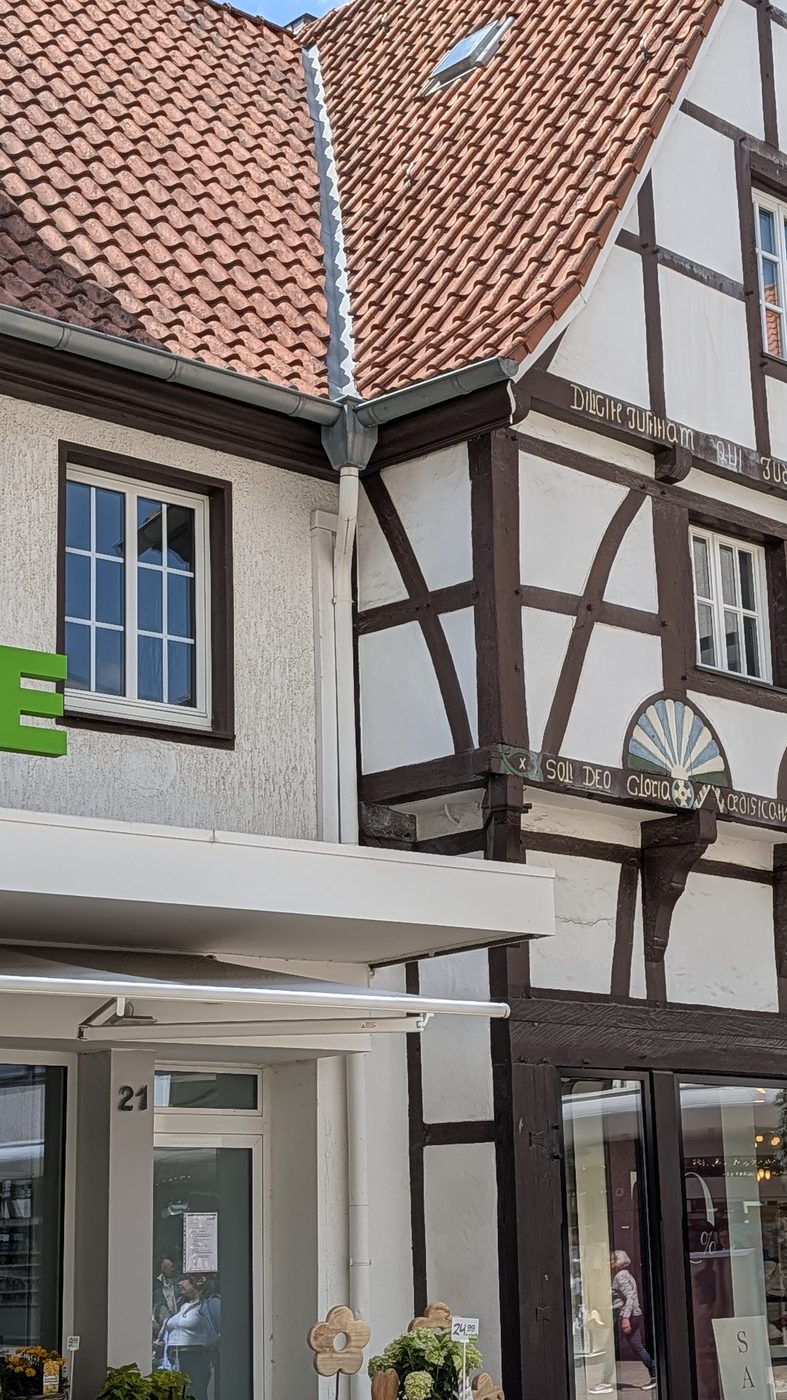
This was taken in a German town center. The beam above the storefront still carries a hand-lettered Latin inscription, which tells you roughly how long this building has been standing there. Look at the drainage, though, because almost every detail in it is doing something:
- The gutter is unpainted half round zinc. That gray is just what zinc does after a few decades outdoors.
- The downspout is round, and it drops off a tapered outlet that was shaped by hand. On an American house you would be looking at a rectangular spout coming out of a boxed corner.
- The gutter sits in external brackets that wrap underneath the trough and anchor back into the roof structure.
- The roof is clay tile, and on the left-hand section there’s basically no fascia board for a gutter to attach to.
That last one is the detail that explains most of the others, so keep it in mind.
Why Europe stayed with half round
There was nothing flat to screw into
Almost all American houses are wood framed, and the rafter tails get covered by a fascia board running the length of the eave. That gives you a flat vertical surface. A K-style gutter has a flat back for exactly that reason: you hold it up, drive screws through the back into the fascia, and move on. It’s fast and it’s cheap.
Plenty of older European construction doesn’t offer you that. You’re working with masonry walls, timber framing, and tile roofs where the rafter tails are either left exposed or finished some other way, and there’s frequently no continuous fascia to fasten anything to. So the gutter gets carried on brackets fastened back to the rafters or the roof deck. And once you’re hanging a trough in open air on curved brackets, a round profile is simply the easiest shape to form, the easiest to support, and the least likely to deform under load.
The metal trades never went away
Germany still has a dedicated trade for this. It’s called a Klempner in the north and a Spengler in the south, and it covers sheet metal roofing, cladding, ornamental work, and rainwater goods as one craft with formal apprenticeship behind it. Forming a half round gutter from flat stock, soldering the seams, hand-shaping the outlets: that’s just ordinary work for someone with that training.
America had tinsmiths doing the same thing. But as building volume exploded after WWII, that skill set mostly got folded into general roofing and siding work, and the whole industry started optimizing for speed instead of craft.
The materials suit the shape
European systems lean heavily on titanium zinc and copper rather than aluminum. Both develop a protective patina, and both routinely last 60 to 100 years. If you’re installing something meant to outlive you, it makes sense to pick a profile with no internal corners for water to sit in and no folded creases to crack as the metal expands and contracts through decades of freeze-thaw.
There’s a standards layer underneath all of this too. European half round gutters are built to EN 612, which sorts them into classes by bead diameter and section modulus, with the brackets covered separately under EN 1462. When the standard, the material, the hardware, and the trade all assume a round profile, nothing much is going to dislodge it.
Why America went K-style
It was designed to look like trim
K-style arrived in the mid-1940s and took over quickly, and the appeal was mostly visual. That ogee curve on the front face imitates interior crown molding, so the gutter reads as part of the house’s trim package rather than a pipe bolted along the roofline. On a colonial or a ranch with painted trim, it more or less disappears, which is what people wanted.
While we’re here, the name comes up constantly and it’s almost always explained wrong. The “K” has nothing to do with the profile resembling a letter K. It comes from a sheet metal industry list of standard gutter profiles, and this one happened to land eleventh on it. K is the eleventh letter.
It holds more water
This part is a real engineering advantage, not marketing. A roughly rectangular cross section fits more water into the same nominal width than a semicircle can:
| Gutter size | K-style capacity | Half round capacity |
|---|---|---|
| 5 inch | ~1.2 gallons per foot | ~0.9 gallons per foot |
| 6 inch | ~2.0 gallons per foot | ~1.2 gallons per foot |
Call it 20 to 40 percent more capacity at the same stated size. On a large steep roof in a region that gets the kind of summer downpours we get around the Chesapeake, that margin is worth having. It’s also why the standard fix for a half round system is just to go up a size. A 6-inch half round paired with 4-inch round downspouts handles serious water without any trouble.
Then the machines showed up
This is probably the biggest factor of the three. Portable roll-forming machines that produce seamless aluminum gutters on site appeared between roughly 1960 and 1965, right as American suburbs were being built faster than at any point before or since. A crew could pull up to a house, run continuous gutter cut to the exact length of each eave, and hang the whole thing that afternoon. No soldering, no joints every ten feet, no shop time.
Those machines were built around the K-style profile. Today about 70 percent of gutters installed in the US are seamless aluminum, and roughly 85 percent of American homes have K-style on them. Not because homeowners sat down and compared profiles, but because that’s what came off the truck.
Half round gutters: the honest pros and cons
Where they win
- They stay cleaner. With no inside corners, there’s nothing for grit and shingle granules to pack into. Debris tends to follow the curve and keep moving toward the outlet.
- They corrode more slowly. A K-style gutter holds a shallow film of standing water on its flat bottom after every storm. A curved bottom funnels that water into a narrow channel that drains and dries faster, and there are no folded creases to fatigue and split open.
- Freeze-thaw treats them better, since expansion gets distributed around a curve rather than concentrating at folded corners.
- Cleaning them by hand is easier. A gloved hand or a scoop follows the curve. Nothing wedges into a 90-degree crease.
- On the right house they look correct. Tudors, Spanish Colonials, stone and stucco homes, historic renovations, anything with real architectural intent. Half round looks deliberate on those. K-style can look like something the builder had left over.
Where they cost you
- Less capacity at the same size, as covered above. Usually solved by upsizing.
- Higher price. Figure 20 to 40 percent more than comparable K-style, between the profile itself, the heavier gauge material, and the specialized brackets.
- Fewer gutter guard options, because most guards on the market were built around K-style. Half round guards exist, but the list is shorter and fit matters more.
- Installation skill genuinely matters. Bracket spacing, pitch, and outlet fabrication are far less forgiving than screwing a flat back to a fascia board. This is not a weekend project.
K-style gutters: the honest pros and cons
Where they win
- Best capacity per inch of width, which counts on large or steep roofs.
- Lowest installed cost by a comfortable margin.
- Every guard on the market fits them, so you get real choice on leaf protection.
- They blend into the trim on typical American housing stock, which is what most homeowners are after.
- Fast seamless installation with no section joints to leak.
Where they cost you
- The inside corner collects debris. That crease where the front curve meets the flat bottom is a genuine trap.
- Standing water on the flat bottom shortens the life of aluminum and steel.
- Harder to clean, because you’re digging compacted muck out of a corner instead of sweeping a curve.
- Wrong look on some homes. On a stucco Mediterranean or a slate-roofed historic house, that faux crown molding profile can read as cheap.
So which one belongs on your house?
K-style makes sense if your home is standard American construction with painted fascia and trim, you want the most capacity for the money, you want the widest range of gutter guards, or budget is driving the decision. There’s nothing wrong with K-style. It’s everywhere because it works.
Half round makes sense if your home has real architectural character, or you’re in a historic district with appearance requirements, or you’re planning to stay put a long time and want a profile that stays cleaner and lasts longer. It also makes sense if you simply like the look better. That’s a perfectly good reason to spend more on something that’s going to be bolted across the front of your house for the next thirty years.
If you do go half round, size up. Six-inch half round with 4-inch round downspouts puts you in the same capacity range as 5-inch K-style, which takes the only real functional objection off the table.
You can get the European look here
Half round isn’t some specialty import you have to order from overseas. Next Day Gutters installs seamless half round gutters, and we’ve been doing it for years alongside our standard work across Maryland, Virginia, and DC.
What that includes:
- Seamless half round in 5-inch and 6-inch, formed to the length of your run so there are no section joints to leak
- Round downspouts in 3-inch and 4-inch, which is the correct pairing and a big part of why the European look reads as authentic
- Aluminum in a range of colors, including white and royal brown
- Copper half round for homeowners who want the real thing, patina and all
- Galvanized steel half round, which is the closest match to what you’re looking at in that German photo
- Quality half round hangers, because the bracket is what separates a half round job that lasts from one that sags in five years
Copper and galvanized are worth knowing about if you’re in a historic district, since those are occasionally required outright rather than just encouraged.
Our gutter types page lays out every profile and material we install side by side if you want to compare. When you’re ready for numbers, you can request a quote or give us a call. We’ll tell you straight whether half round is worth it on your particular roof or whether you’d be paying extra for something you won’t notice.
Frequently Asked Questions
Are half round gutters better than K-style gutters?
Neither one is better across the board. Half round stays cleaner, resists corrosion longer, and suits architecturally distinctive homes. K-style holds 20 to 40 percent more water at the same nominal size, costs less to install, and works with far more gutter guard products. Which one is right depends on your roof, your budget, and your home’s style.
Why does Europe use half round gutters instead of K-style?
Largely because of how the buildings are put together and who does the metalwork. Older European buildings often have no continuous fascia board for a flat-backed K-style gutter to screw into, so gutters hang on brackets, and a round profile is the easiest shape to form and support that way. Europe also kept its dedicated sheet metal roofing trades and built its standards, materials, and hardware around half round.
Do half round gutters clog more easily than K-style?
No, generally less. Half round has no inside corners for debris to pack into, and the curved bottom keeps water and debris moving toward the outlet. The tradeoff is that it holds less water overall, so going up to 6-inch is smart on larger roofs.
How much more do half round gutters cost?
Typically 20 to 40 percent more than comparable K-style. The profile takes more material, heavier gauge stock, and specialized brackets. Copper half round runs considerably more than aluminum but can last 60 to 100 years.
Can you put gutter guards on half round gutters?
Yes, though the options are narrower since most guards were designed for K-style. Fit matters more on half round, so it’s worth settling on a guard before installation rather than after.
Does Next Day Gutters install seamless half round gutters?
Yes. We install seamless half round in 5-inch and 6-inch aluminum with round downspouts, plus copper and galvanized steel half round for homeowners who want the traditional European look. There’s more detail on our half round gutters page.
What size half round gutter do I need?
Six-inch half round with 4-inch round downspouts is the safe choice for most homes and puts capacity in the same range as 5-inch K-style. Five-inch can work on smaller roofs with modest pitch. Roof area, pitch, and local rainfall intensity all factor in, which is what an estimate is for.